Canister Vacuum Cleaners: What to Compare Before You Buy
By Martin Butler · Published · Updated · 6 min read
Canister vacuums put the motor and dust collection in a body that rolls or slides behind you, with a hose and wand doing the cleaning. That layout makes them heavier to store but far easier to push across bare floors, under beds and up stairs than an upright, which is why they remain the default choice in many European and Asian homes.
This guide covers what actually changes day-to-day performance: real suction and airflow figures, bagged versus bagless running costs, filtration for allergy sufferers, and the handling details — weight, cord length, hose reach — that reviews tend to skip. Expect to pay roughly £120–£250 for a solid mid-range model and £300–£600 for a premium machine with better filtration and quieter operation.
Suction, Airflow and What the Numbers Mean
Suction is usually quoted in kilopascals (kPa) or air watts (AW). Most decent household canister vacuums land between 15 and 25 kPa, or roughly 200–400 AW on the EU energy label scale. Higher numbers help on carpet, but a machine with strong airflow and a well-sealed floor head will out-clean a higher-rated vacuum with leaky joints and a clogged filter.
Airflow, measured in litres per second, matters more than raw suction on hard floors, where you are lifting loose debris rather than pulling it out of pile. Look for 30–40 litres per second on mid-range models. Variable power is genuinely useful: you rarely need full power on a tiled kitchen floor, and dropping to a low setting adds years of life to the motor and cuts noise considerably.
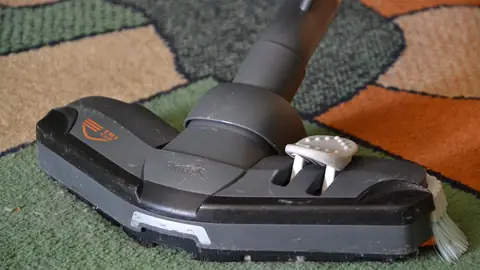
Carpet performance depends on the floor head as much as the motor. A motorised brush roll with height adjustment transforms results on medium-pile carpet, while a simple combination head is fine for hard floors and low-pile rugs. If your home is mostly hard flooring with a couple of rugs, spend your budget on filtration and hose quality rather than maximum suction.
- 15–25 kPa is typical for household canister vacuums
- 200–400 AW on the EU energy label scale
- 30–40 litres per second airflow for mid-range models
- Variable power is more useful than a high fixed maximum
Bagged vs Bagless: Running Costs and Mess
Bagged canister vacuums cost more per year in consumables but are cleaner to empty and usually hold filtration better. A typical bag holds 2–4 litres and needs changing every 1–3 months in a normal home, with genuine bags costing roughly £8–£15 for a pack of four. That works out at perhaps £30–£60 a year, more if you have pets or a lot of carpet.
Bagless models save on bags but need the bin emptied after most cleans, and the filters must be washed monthly and replaced every 6–12 months at £10–£25 a set. In practice the cost difference is modest; the real trade-off is convenience. Emptying a bagless bin over a kitchen bin releases a visible puff of fine dust, which matters if anyone in the house has asthma.
If you choose bagless, look for a bin of at least 1.5 litres and a design you can empty without reaching inside. If you choose bagged, check that own-brand or compatible bags are widely available — a machine tied to expensive proprietary bags can cost more over five years than the vacuum itself.
- Bagged: roughly £30–£60 a year in bags
- Bagless: £10–£25 a year in filters, plus a bin to empty each clean
- Bagless bins under 1.5 litres need emptying mid-clean
- Check bag availability before buying an older or obscure model
Filtration and Indoor Air Quality
Every canister vacuum pushes air back into the room, so filtration is a health feature, not a marketing one. Basic models use a single motor filter; better ones add a pre-motor filter and a HEPA exhaust filter rated H13 or H14, which captures the vast majority of fine particles. For allergy sufferers, a sealed system with a HEPA exhaust filter is the specification worth paying for.
Filtration only works if the seals hold. Cheap plastics that flex, a hose that pops loose and a full bag all let dust bypass the filter entirely. When you handle a machine in a shop, check the fit of the bin lid, the hose couplings and the floor-head neck — a slightly heavier vacuum with tight joints beats a light one that leaks.
Washable filters need drying fully before refitting; a damp filter is a breeding ground for odour and mould. Most manufacturers suggest rinsing every 4–6 weeks and replacing annually, and performance drops noticeably once a filter is clogged with fine plaster or flour dust.
- Look for a HEPA H13 or H14 exhaust filter
- Sealed joints matter as much as the filter rating
- Wash filters every 4–6 weeks; replace annually
- Fine dust from DIY work clogs filters fast
Weight, Hose Reach and Storage
Canister vacuums typically weigh 5–9 kg, and the difference is felt when carrying one up stairs or lifting it out of a cupboard. If you clean a two-storey house, a machine under 6 kg with a carry handle is worth more than extra suction. Wheels matter too: large soft wheels roll over thresholds and rugs, while small hard wheels catch on door bars.
Hose and wand reach determine how far you can clean without moving the body. A hose of 1.8–2.2 metres plus a telescopic wand gives around 3–4 metres of working reach, enough to do a full staircase from the landing. Cord length is the other half of the equation: 6–8 metres is standard, and anything under 5 metres means unplugging repeatedly in a normal living room.
Storage is the usual complaint. A canister with a parking clip for the wand and a hose that wraps around the body stores in a cupboard reasonably well, but check the assembled footprint — some premium models are surprisingly bulky even when parked. If space is genuinely tight, a compact canister around 30 cm wide is easier to live with than a large one with a bigger bin.
- 5–9 kg typical weight; under 6 kg suits stairs
- 1.8–2.2 m hose plus wand gives 3–4 m reach
- 6–8 m cord is standard; under 5 m is restrictive
- Check the parked footprint, not just the cleaning size
| Price band | Suction (kPa) | Weight (kg) | Filtration | Bags/filters per year |
|---|---|---|---|---|
| Budget, under £100 | 12–16 | 4–6 | Basic motor filter | £25–£40 |
| Mid-range, £150–£300 | 18–22 | 5–7 | HEPA H13 exhaust | £35–£60 |
| Premium, £300–£600 | 20–25 | 6–9 | Sealed HEPA H13/H14 | £40–£70 |
| Bagless mid-range | 18–22 | 5–7 | Washable + HEPA | £10–£25 |
| Compact canister | 14–18 | 4–5 | HEPA H13 | £30–£50 |
Noise, Controls and Everyday Handling
Noise is quoted in decibels, and the practical range runs from about 62 dB on a quiet low setting to 80 dB or more at full power with a motorised brush. A 10 dB difference is roughly twice the perceived loudness, so it is worth shortlisting quieter machines if you clean while others sleep or work from home.
Foot controls beat bending down, and a mechanical slider is more reliable long-term than a touch panel. Retractable cords should rewind smoothly without whipping; test this before buying if you can. Suction release valves on the handle are a small but genuinely useful feature, letting you lift the floor head off a rug without switching off.
Running costs beyond bags and filters are modest. Motors typically last 7–10 years in a well-maintained machine, and most failures trace back to blocked hoses, overheated motors from clogged filters, or worn brush rolls. Replacing a brush roll every few years at £15–£30 is normal on models with motorised heads.
- 62–80 dB depending on setting and floor head
- Foot controls and a mechanical slider age better than touch panels
- Test the cord rewind before buying
- Most failures come from blockages and clogged filters
Matching the Vacuum to Your Home
A home that is mostly tile and wood with a few rugs needs airflow, a good combination head and a long cord more than it needs maximum suction. A carpeted house with pets needs a motorised brush roll, strong suction at the head and a bag or bin large enough to finish the job without stopping. Someone with allergies should prioritise sealed HEPA filtration above all else.
Hard floors also benefit from a dedicated parquet or hard-floor head with soft bristles, which sweeps rather than scatters debris. Pet owners should look for a turbo or motorised mini head for stairs and upholstery, since the standard head rarely lifts hair from fabric. If you are also improving the house itself, our guide to insulating a container home for hot and cold climates covers the dust and draught issues that make frequent vacuuming necessary in the first place.
Budget sensibly. Below about £100 you get workable suction and basic filtration; £150–£300 buys sealed HEPA filtration, a motorised head and quieter operation; above £400 you are paying for build quality, longer warranties and better hose ergonomics rather than a dramatic jump in cleaning power. If you are kitting out a utility or garden room, small garden greenhouse costs is a useful reminder of how quickly outbuilding budgets add up alongside appliance spending.
- Hard floors: airflow, long cord, soft-bristle head
- Carpet and pets: motorised brush roll plus mini turbo head
- Allergies: sealed HEPA H13 or better
- £150–£300 is the sensible sweet spot for most homes
- Airflow and a well-sealed floor head matter more than headline suction
- Sealed HEPA filtration is the feature worth paying for if anyone has allergies
- Bagged and bagless running costs differ by only £20–£40 a year
- Under 6 kg and 6–8 m of cord make far more difference than extra power
Martin writes and edits practical guides on homes, gardens, technology and property, with a focus on clear numbers and checklists. He has spent years testing household equipment and following small building projects from planning to finishing. His aim is to make everyday buying and building decisions easier to plan for.